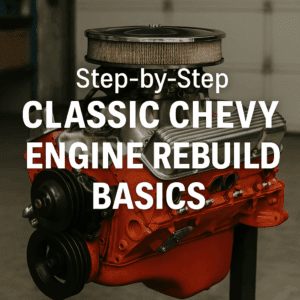

Learn step-by-step how to restore a Chevy Small Block V8. From teardown to startup, get essential Chevy 350 rebuild tips, parts advice, and proven techniques for a reliable engine restoration.
Few engines are as legendary as the Chevy Small Block V8. From the first 265 in 1955 to the famous 350 that powered Camaros, Chevelles, and Corvettes, these engines remain at the heart of the classic Chevy hobby. If you’re planning to restore a Chevy small block, you’re not just rebuilding an engine—you’re keeping history alive.
This guide walks you through the process with practical Chevy 350 rebuild tips that will help ensure your project ends with a reliable, roaring V8 under the hood.
Step 1: Planning and Assessment
Start with a full inspection of the block. Determine if it’s original to your car, whether it’s standard bore, and the condition of the crank, cam, and heads. Check casting numbers and VIN stamps—especially if originality matters.
If your goal isn’t numbers-matching originality, you’ll have more flexibility to use performance parts such as aftermarket heads or a modern roller camshaft.
Even a healthy small block can refuse to fire after downtime, especially when fuel evaporates or ignition components degrade, which is why many owners deal with classic Chevy starting problems after sitting.
✅ Decode the block casting date using the Small Block Chevy Date Code Decoder to confirm the engine falls within the correct production year.
👉 See our detailed Chevy VIN verification guide for step-by-step tips on confirming authenticity.
Step 2: Disassembly and Cleaning
As you tear down the engine, label every part. Bag and tag bolts, rods, and valvetrain components, and take photos to track orientation.
Once stripped, the block should be hot-tanked or chemically cleaned to remove decades of grime. Carefully inspect for cracks or warpage. A machine shop can magnaflux and pressure-test the block to confirm it’s usable.
Step 3: Machine Work
Precision machining is critical to long-term reliability. A quality machine shop will:
- Bore and hone cylinders to the next oversize (commonly +.030)
- Align-hone the mains
- Deck the block for proper surface finish
- Balance the rotating assembly
Skipping this step often leads to costly problems down the road.
Step 4: Parts Selection
The parts you choose depend on your goal—restoration or performance.
- Stock restoration: Stick with OEM-spec pistons, camshaft, and heads.
- Performance build: Upgrade with forged pistons, aftermarket heads, and a hotter cam profile.
For authenticity, resources like Chevy engine casting number databases will help you match correct parts to your model year.
Step 5: Assembly Tips
This is where careful work pays off. Here are some proven Chevy 350 rebuild tips:
- Apply assembly lube generously to bearings, cam lobes, and lifters.
- Verify bearing clearances with Plastigage before final torque.
- Use proper torque specs and sequences with a calibrated wrench.
- Degree the camshaft instead of relying on timing marks alone.
- Prime the oil pump before startup with a drill-driven tool.
👉 For more inspection and prep advice to restore a Chevy smallblock, don’t miss our Classic Chevy Buyer’s Guide and The Utimate Classic Chevy Restoration Guide
Step 6: Initial Startup
The first startup is critical to engine life. Fill with break-in oil, prime the pump, and fire the engine quickly to 2,000–2,500 RPM for 20 minutes. This procedure ensures proper cam and lifter break-in.
Watch oil pressure and coolant temperature closely. After break-in, change the oil and filter, then re-torque the heads and intake.
Step 7: Long-Term Care
With proper care, a restored Chevy Small Block will run for decades. Stick to regular oil changes, check ignition timing, and adjust valve lash when needed.
Joining a community such as the ChevyTalk forum connects you with enthusiasts who share rebuild tips, troubleshooting advice, and rare parts sources.
Get Started
To restore a Chevy small block is to take part in a tradition that spans generations of car lovers. Whether you’re after originality or performance, a methodical approach—inspection, machining, precise assembly, and careful break-in—will give you an engine that sounds as sweet today as it did 50 years ago.
If you’re just starting a project car journey, check out our Chevy History & Evolution article to see how these engines shaped the golden age of American performance.